Growth is the plan almost everywhere: in Hostaway’s 2026 Short-Term Rental Report, 45% of operators said they intend to add properties this year. The workload is the catch, because in Touch Stay’s 2026 survey, nearly half of hosts managing 11 or more properties already spend over 21 hours a week on management. That is the real question behind how to scale an Airbnb management company: how do you add doors without adding a hire for every ten of them?
45%
of operators plan to add more properties in 2026
Source: Hostaway 2026
Here is what the load looks like at scale, using our standing baseline for a company running about 50 listings (estimate, ~50-listing basis):
| The work | Every month at ~50 listings |
|---|---|
| Cleaning turnovers | ~750 to schedule, confirm, and verify |
| Guest conversations | ~40 new threads a day, around the clock |
| Owner statements | ~25 owners expecting clean numbers |
| Ops tickets | ~40 repairs, refunds, and claims to route |
Where scaling actually breaks
Every door you add multiplies four queues at once:
- The inbox grows fastest, and it never closes for the night.
- Cleaning coordination turns into a daily puzzle of who confirmed what.
- Maintenance ownership blurs, and problems wait in group chats.
- Month-end reporting becomes an evening of spreadsheets per owner.
The standard playbook for how to scale an Airbnb business answers with more automation and more people: a PMS for templates and calendars, a scheduling tool for cleaners, a VA for the inbox. Each helps, and each adds another dashboard someone has to watch. The watching is what still scales linearly with doors.
The AI ops layer that scales without headcount
The market is already moving this way, and fastest at the top end.
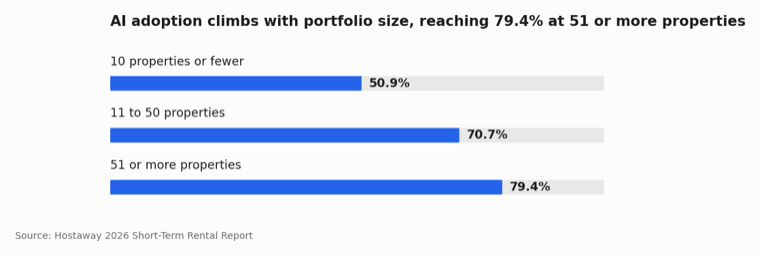
Source: Hostaway, 2026 Short-Term Rental Report.
One approver, every property
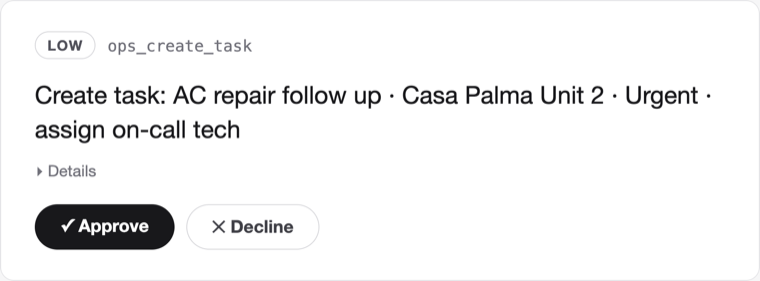
The agent proposes actions and cannot execute anything on its own. You tap Approve, and the system creates the ticket, assigns the on-call person, and notifies the cleaner. One person’s judgment now covers the whole portfolio, because judgment is the only part still human sized.
The knowledge base builds itself
Answers your team gives in chat can be captured into a reviewed knowledge queue, and anyone can save a fact with a quick bot mention. New properties and new hires stop depending on what one veteran remembers.
The AI watches the whole portfolio
Every 15 minutes the system scans all properties for guests waiting too long, stalled tasks, messages that read like repair problems, and low reviews. Each hit lands in one approvals inbox instead of 50 separate screens. You configure the rules and thresholds once.
Owner statements run themselves
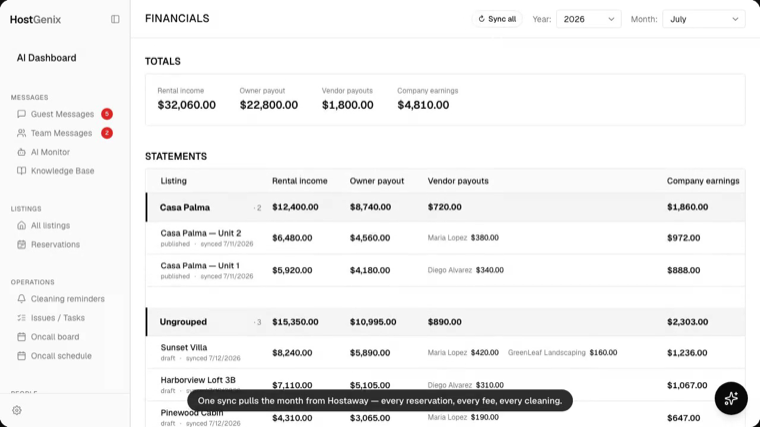
Twenty five owners no longer means twenty five spreadsheet evenings. Each statement pulls the month with one sync, you review and publish to freeze the numbers, and the PDF goes out. That single workflow is worth an estimated 30 to 45 staff hours a month (estimate, ~50-listing basis).
How many properties can a property manager manage?
With manual operations, most people hit a wall long before the math does. With the drafting, watching, and reporting systemized, our working estimate is that 1 to 1.5 full-time operators can support around 50 listings (estimate, ~50-listing basis). We broke down the hours behind that number in how much time an Airbnb takes to manage, and the five problems that start at 5+ listings show where the wall usually appears first.
For a look at the approval flow handling real scenarios, see the AI property management case study.
FAQ
How do I scale my property management company?
Systemize the four queues that grow with every door: guest messages, cleaning, maintenance, and owner reporting. Add an AI ops layer that drafts and watches while one person approves, and hire for judgment rather than coverage.
Do I need to hire more staff for every new listing?
Not linearly. Staff scale with decisions, not with doors, once drafting, monitoring, and reporting run on systems. The hires you do make go to guest experience and owner relationships instead of inbox coverage.
What slows down growing a vacation rental management company?
Usually the watching: someone has to notice the late reply, the stalled clean, and the unbilled expense. Tools that execute tasks but leave the noticing to people are why teams grow as fast as portfolios.