A guest reports a dripping shower on Tuesday, someone tags the handyman in the group chat, and by Friday nobody can say whether it was fixed. It adds up: in Hostaway’s 2025 Summer Snapshot survey of 320 property managers and owners, four in ten ranked property maintenance among their top three challenges, and the same survey found property condition and cleanliness top the guest complaint list. The root cause is rarely effort: the usual ways to keep track of Airbnb maintenance scatter reports, follow ups, and repairs across different places, with no single path from reported to fixed.
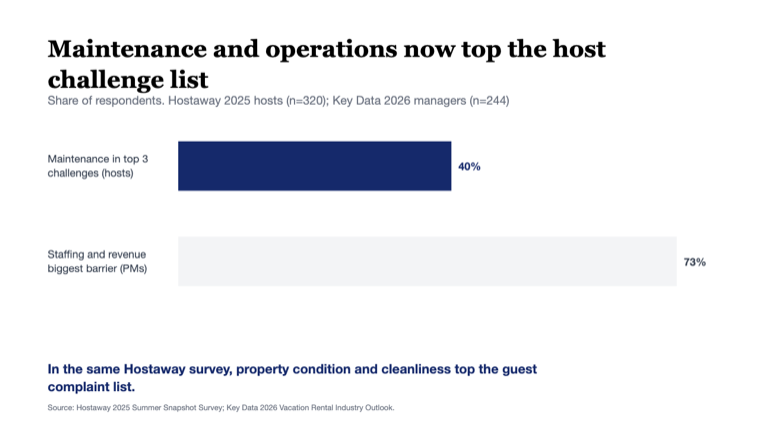
Source: Hostaway (2025 Summer Snapshot, n=320); Key Data (2026 Outlook, n=244).
How do most hosts keep track of Airbnb maintenance?
Most hosts run some mix of three manual habits:
- An Airbnb maintenance tracking spreadsheet, one tab per property, updated whenever someone remembers.
- Periodic follow ups: a weekly scroll through the group chat asking “did the plumber ever come?”
- Asking cleaners to keep an eye out. Their findings arrive as texts and photos that scroll away.
Each habit works at two listings and starts leaking at five. Vacation rental maintenance software covers slices of the job:
- Turno runs a cleaner marketplace with auto scheduling and photo checklists, but a cleaner’s problem report is not a work order with an owner and a history.
- Breezeway syncs data from your PMS and schedules turnover and recurring maintenance tasks, as a separate operations layer with its own subscription.
- Generic task apps like Trello or Asana give you boards and reminders with no connection to bookings, listings, or cleaners.
- Most PMS platforms include a basic task list. Fields are thin and there is no escalation path.
None of them, on its own, connects the report, the owner, the fix, and the proof in one place.
Remote hosts and growing portfolios feel it first. Off site, every issue reaches you secondhand, and small problems quietly age into bigger maintenance costs. The same Hostaway survey found portfolios of 50 plus properties called out staffing and turnover as additional pain points, and operators in Key Data’s 2026 Outlook (244 surveyed) ranked efficiency across staffing, guest service, and property care their top priority for 2026.
One ticket for every issue: how HostGenix keeps track of maintenance
HostGenix builds the tracker into the same platform that runs your cleaning, messaging, and finances. Under Operations › Issues / Tasks, every problem becomes a ticket with a category, priority, owner, and status. Categories cover repairs, refunds, damage claims, security deposits, and recurring preventive maintenance like pest control and lawn care.
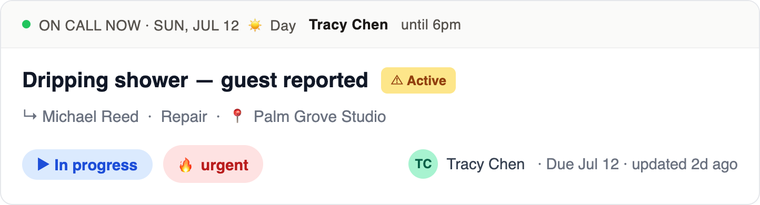
Logging takes about ten seconds. Click New issue / task, type a title, pick a category. Tag the source (guest message, review, or cleaner) and link the reservation so listing and guest details fill in on their own.
Every ticket gets an owner and a deadline. Assign a teammate, or urgent tickets can auto assign to whoever is on call that day. One click escalates a stuck issue to the duty manager, and due dates, vendor, and appointment time sit on the ticket instead of in your head.
Nothing disappears into a thread. Tickets move through open, in progress, waiting, and done, and the board shows open work by default. The work history logs every change and comment, and attachments hold photos, videos, or PDFs up to 25MB as evidence.
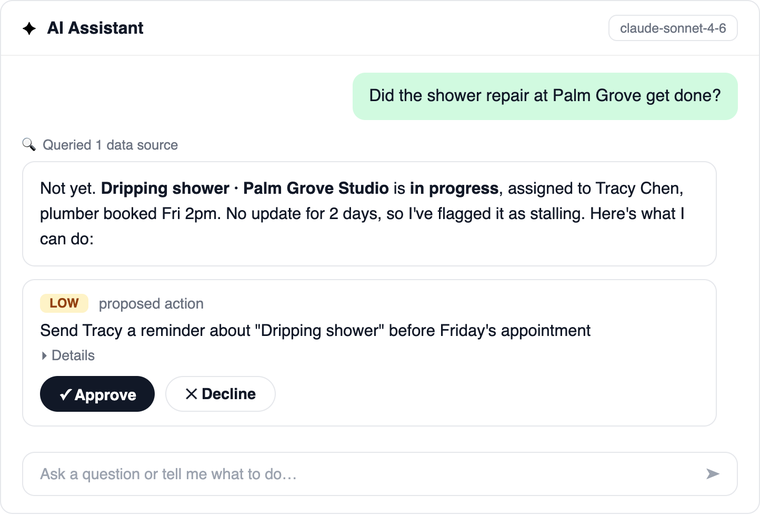
The AI checks whether work actually got done. An AI agent for Airbnb operations runs proactive scans in the background and flags tickets that stall: assigned but untouched, waiting on a vendor too long, past their due date. It proposes the fix, a nudge or a reassignment, as an action you approve with one click, so a forgotten repair resurfaces on its own instead of in a guest review.
Your cleaners become the intake. Cleaning reports flag damage, missing supplies, and lost items at every turnover, and you review them remotely with a pass or fail. A flagged photo becomes a ticket you log in seconds, days before the next guest would have found the problem.
The payoff: every repair owned, every claim documented
A 50 listing operation handles roughly 40 tickets a month, and moving them out of chat threads saves an estimated 10 to 15 hours a month (estimate, ~50 listing basis). The bigger win is that nothing slips: every repair has an owner, and every claim has its photos when you need them. That is AI maintenance tracking without the spreadsheet.
If maintenance keeps dying in your group chat, give it a tracker instead.
Maintenance is one half of property care; the cleaning half is in our Airbnb cleaning management guide. For the wider picture, here is AI property management beyond guest messaging.
FAQ
How do you handle Airbnb maintenance during a stay?
Log it as an urgent ticket so it auto assigns to whoever is on call, and record whether the guest granted permission to enter. The ticket also carries the vendor appointment, so nobody shows up unannounced.
How do you document damage for an Airbnb claim?
Open a damage claim ticket and attach photos or video before the repair. The ticket keeps the reservation reference, the amount filed, and a timestamped work history, so the whole evidence chain sits in one place when you file.
What should an Airbnb maintenance checklist include?
Cover the recurring items on a calendar cadence: pest control, lawn care, carpet cleaning, and filter or appliance checks between stays. Run each as its own ticket category so the cadence is visible and missed rounds show up as open tickets.
Does HostGenix create maintenance tickets automatically?
No. Logging is manual on purpose and takes about ten seconds, so the record stays clean. The automation sits around the ticket: urgent auto assign, escalation to the on call manager, cleaning report flags, and AI scans that flag stalled tickets and propose the next step.