Ask any rental app what its AI does and the answer is some version of “it replies to guests.” Hospitable’s 2026 industry report (554 hosts and managers) shows the pattern: 89.9% call property-management software essential, yet AI adoption sits in just two lanes: 80.9% guest communication, 62.6% pricing.
That’s not because the models are limited. It’s because AI for Airbnb hosts has been wired to exactly one data source: the inbox.
The same model, connected to your whole operation, can work as an external brain: it remembers, it watches, and it checks its own work.
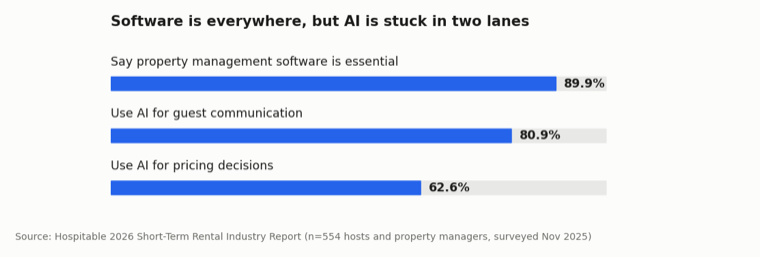
Source: Hospitable 2026 Short-Term Rental Industry Report (n=554, surveyed Nov 2025).
AI beyond guest messaging? The market stopped at the inbox
Scan the vacation rental AI tools and the pattern repeats:
- An AI chatbot for Airbnb hosts (HostBuddy, Guest Guru, Besty AI all fit the label) puts the LLM to work saying things: guest communication automation, full stop.
- PMS inbox AI drafts replies where reservations live. Same lane.
- Your memory still holds the rest: which unit’s lockbox sticks, which guest sounded angry, whether the AI’s answers this week were any good. You are the database, the triage desk and the QA team.
Current models are comfortably capable of all three jobs. They just need what a brain needs: a connected body. Bookings, messages, tasks and reviews have to flow through one system, which is what a connected operations platform provides.
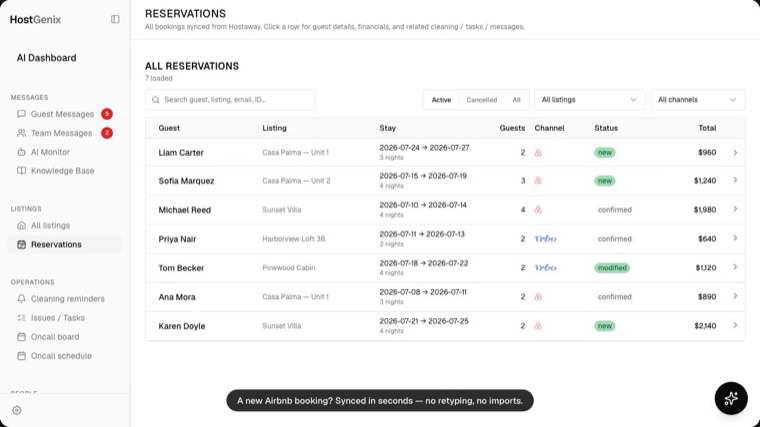
Job 1: it remembers, so you can stop being the wiki
In HostGenix, teaching your knowledge base AI is a chat message. In your Lark team group, type remember: Unit 5 lockbox code is 4821, tell guests to use the side door, and:
- The bot classifies it, files it in the Knowledge Base, links it to the listing, and replies “Noted!”
- From then on, every AI guest reply is grounded in that knowledge.
- Outdated fact?
forget: lockboxarchives it.
Maintenance cost of your operational memory: one sentence.
It also learns in the other direction, with a safety valve: facts the AI picks up from guest conversations (opt-in) land in a pending queue for human approval. It drafts what it learned; you decide what sticks.
Job 2: it reads every message first
Every inbound guest message gets risk-assessed on arrival:
- A rules layer catches the unambiguous: refund demands, safety incidents, legal threats.
- An LLM layer classifies intent: complaint, maintenance issue, cleaning issue.
- The verdict lands on the conversation itself.
Your dashboard’s Escalated messages list then shows only what needs a human: unreplied, recent, medium or high risk, highest risk on top, each row with the reason spelled out.
This is AI guest message triage, nothing more. It doesn’t answer the angry guest for you. It makes sure you see “this is unacceptable, I want a refund” before “any chance of a late checkout?”.
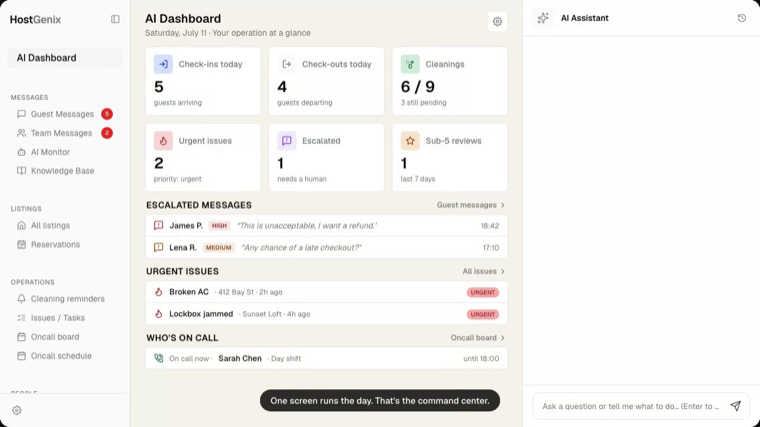
The same screen is where “remind me” stops being a sticky note: sub-5★ reviews from the last 7 days, urgent issues, and who’s on call sit in one view, so the items that need attention surface on their own.
Job 3: it audits itself
If an LLM answers your guests, “how good is it?” can’t be a feeling. The AI Response Monitor (Messages › AI Monitor) tracks every AI reply’s fate:
- Accepted, edited or rejected, with rates by model and by message category, plus response latency.
- Human shortcuts count too: a teammate who never clicks Accept but sends nearly the same text gets caught by similarity matching.
- Adoption rate drops? You’ll see it in numbers, and the fix is usually Job 1: teach the Knowledge Base what it was missing.
The payoff of AI for Airbnb hosts: attention, not typing
Auto-replies alone are worth roughly 30 to 60 hours a month (estimate, ~50-listing basis), and that’s the lane most LLM property management tools already run in.
The three jobs above are what the same model adds on top:
- Your operational memory stops living in your head.
- Your inbox pre-sorts itself by risk.
- Your AI’s quality becomes a dashboard instead of a vibe.
And if you want the brain to also do things (create the repair task, chase the stalled ticket), that’s the next step: the AI assistant that proposes actions you approve.
FAQ
What can AI do for Airbnb hosts besides answering guests?
Three jobs beyond messaging: keep your operational knowledge (taught in one chat message, used in every reply), triage inbound messages by risk so the urgent ones surface first, and audit its own reply quality with acceptance and edit rates per model.
What is the best AI for Airbnb messages?
Messaging is the entry lane, and plenty of tools draft solid replies. The difference is what happens around the message: does the AI remember your ops facts, flag risky conversations first, and report its own accuracy? Judge those three jobs, not reply quality alone.
Does the AI escalate guest complaints automatically?
It flags them. Each inbound message is risk-classified (rules plus LLM intent detection), and medium/high-risk unreplied conversations surface on the dashboard sorted by risk, with the reason shown. Acting on them stays with your team.
Fifteen minutes to connect, and the brain starts on day one.