How much time does it take to manage an Airbnb? Anywhere from a few hours a week to a full day every time a guest checks out.
In Touch Stay’s 2026 survey of 1,363 hosts, 43% keep guest management under five hours a week, yet among hosts running 11 or more properties, nearly half spend over 21 hours. The hours rarely go to one big task: they go to watching everything at once, because no single tool owns the whole workflow. Here is where the average time spent managing an Airbnb actually goes, and what is left once an AI operations layer takes over.
| The job | Without a system | With an AI ops layer |
|---|---|---|
| Guest messages | You answer the same questions at all hours | AI drafts every reply 24/7, you tap Send |
| Cleaning and turnovers | You text cleaners after every booking change | Tasks create themselves, photos prove the work |
| Maintenance | Problems live in group chats until someone remembers | Issues become tickets, the on-call person is notified |
| Month-end statements | An evening in spreadsheets per owner | Sync, publish, send the PDF |
| Watching it all | You, always | AI scans every 15 minutes, you just approve |
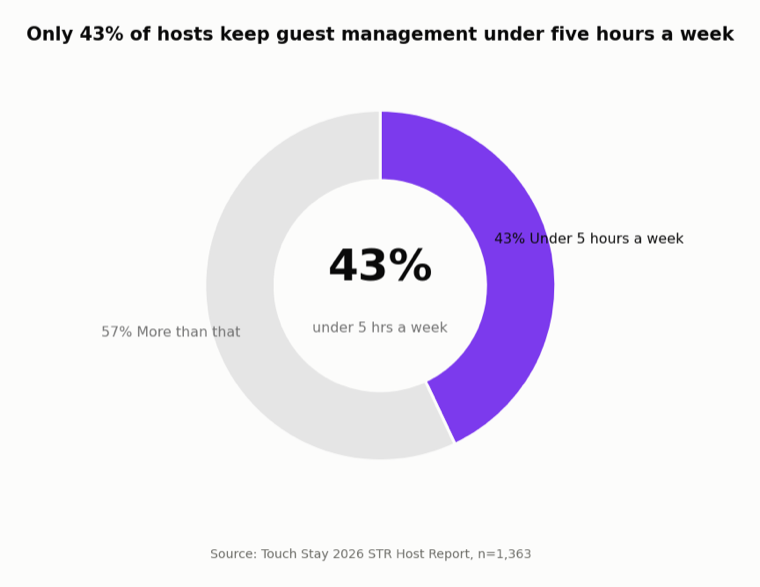
Source: Touch Stay, 2026 STR Host Report (n=1,363).
How many hours a week does it take to manage an Airbnb?
For one listing, plan on a few hours most weeks, with turnover days running far longer. How much time it takes to run an Airbnb scales with bookings rather than listings alone. If you are managing an Airbnb while working full time, every hour above that budget comes out of your evenings.
Hosts have tried to automate the edges for years:
- Airbnb’s own scheduled messages cover check-in instructions.
- Smart locks cover the door.
- Tools like Turno cover cleaner scheduling.
- A property management system adds message templates and calendar rules.
Adoption is not the problem. In the same Touch Stay survey, 82% of hosts use at least one automation tool, yet 56% still handle guest communication manually. Each tool shaves one task and hands the watching back to you, which is how the ten silent time drains survive even in automated setups.
What changes when AI takes over the busywork
Rule-based tools run whatever you predefined. The 2026 shift is an AI operations layer that drafts, watches, and executes while you stay the approver. In Hostaway’s 2026 Short-Term Rental Report, 60.7% of operators said they used AI in 2025, and 60% named guest communication as the place it made the biggest difference.
AI drafts every guest reply, and you tap Send
Every incoming question gets a drafted answer within seconds, day or night. The draft waits as an unsent bubble in your inbox: you edit, send, or discard it, so nothing reaches a guest without a person behind it.
43%
of operators save 2 or more hours a week with AI, double last year’s 20%
Source: Hostaway 2026
Cleaning schedules itself, and photos prove the work
A new booking creates its own cleaning task, assigned to the right cleaner and deduplicated when the calendar shifts. The cleaner submits photos and a checklist from their phone, and you pass or fail the clean remotely instead of trusting a text that says all done.
The AI watches the operation so you do not have to
Every 15 minutes the system scans for what you used to catch by staring at screens: a guest waiting too long, a task that stalled, a message that reads like a repair problem, a review that came in low. Each hit becomes a proposal in your approvals inbox. You choose which rules run and set the thresholds.
It proposes, you approve, and it executes
The agent cannot write anything on its own, so every action starts as a proposal card. One tap on Approve creates the ticket, assigns the on-call person, and notifies the cleaner over WhatsApp or SMS.
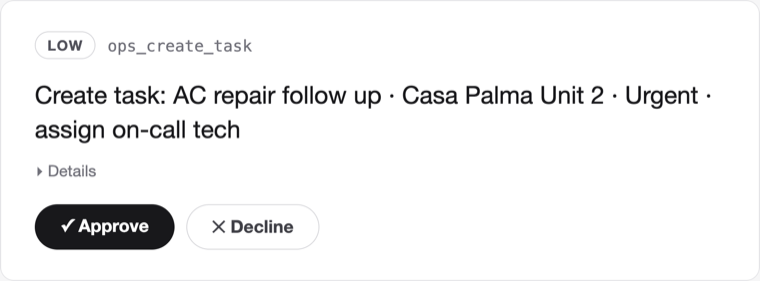
The old chain of see it, judge it, open a ticket, assign it, and message someone collapses into a single decision.
Month-end runs itself
Owner statements pull the whole month with one sync, income and expenses already in place. You review, publish to freeze the numbers, and send the PDF. Across the full stack, that is an estimated 180 to 260 staff hours saved per month (estimate, ~50-listing basis).
How many Airbnbs can one person manage?
Without systems, the ceiling is your calendar, and airbnb host burnout arrives before the tenth listing. With the watching and drafting handed off, roughly 1 to 1.5 full-time operators can support a portfolio of around 50 listings (estimate, ~50-listing basis). Hostaway found AI adoption already reaches nearly 80% among operators with 51 or more properties.
How to spend less time managing your Airbnb
There are three realistic paths, and only one keeps both your margin and your evenings:
- Keep doing everything manually and accept the hours.
- Hand the keys to a manager and give up a slice of revenue, the classic trade of self-managing versus hiring a property manager.
- Keep control and let an AI operations layer handle the drafting and the watching while you approve.
Start with whichever task eats your week: AI drafted replies for messaging, or auto-scheduling and photo checks for cleaning chaos.
For the tool-by-tool version, see our guide to Airbnb automation tools or the step by step walkthrough of automating your Airbnb.
FAQ
How difficult is it to manage an Airbnb?
The individual tasks are simple, but the coordination is relentless: several easy jobs all want attention at once. Difficulty scales with bookings and team size rather than the property itself.
Is running an Airbnb stressful?
The stress mostly comes from being permanently on call for messages, cleaners, and surprises. Hosts who automate drafting and monitoring keep the judgment calls and lose the constant vigilance.
Is Airbnb hosting passive income?
Not by default. Surveys put real management time anywhere from a few hours a week to more than 21 hours at scale, and it only approaches passive once drafting, scheduling, watching, and reporting run on systems.